

Interview: Indie Publishing Perspective
With Multi-published and Award-winning Author Erin Dionne

I’m thrilled this week to bring you an interview with one of my author friends from way back when we both started out as baby writers, Erin Dionne. Erin is both traditionally published and has taken back rights for her out-of-print books and re-released them herself. Now she’s releasing a new previously unpublished collection herself, as well.
Erin is the primary inspiration for what I’m doing, too. I’m sure she has bits of wisdom that will enhance the information I’ve been sharing.
Here’s her bio: Erin Dionne writes middle grade novels, picture books, chapter books and nonfiction. Her spooky chapter book series Shiver-by-the-Sea (Pixel + Ink) features magic, movie monsters, friendship, and SEL themes. Her novel Moxie and the Art of Rule Breaking was an Edgar finalist in the Juvenile Fiction category. Her latest novel for tweens is Secrets of a Fangirl (Scholastic 2019). Her most recent picture book is Balletball (Charlesbridge, 2020). When not writing, she’s a professor at Montserrat College of Art in Beverly, MA.
On to the Interview!
Q: The short webinar that you offered to some of us authors about a year ago was the inspiration that started me self-publishing my out-of-print (OOP) books. What was your impetus for doing the same?
I’m so glad the webinar helped get you on this path! For me, a few things came together to set me moving in this direction: I started listening to The Creative Penn Podcast, where author Joanna Penn frequently spoke about rights and licensing agreements. I’m also a Swiftie, and watching Taylor Swift re-record her masters to own her work was another nudge. Lastly, I saw the way that AI was rolling out and what happened with the Anthropic court case, and that solidified things for me: As a creative person, my work is my “product.” When my books have had their publishing run, that doesn’t mean they can’t still have a life with me. So I decided to learn how to resurrect those titles.
Can you describe how you went through the discovery process – what works best, what options to consider, how long it took to feel comfortable with this process?
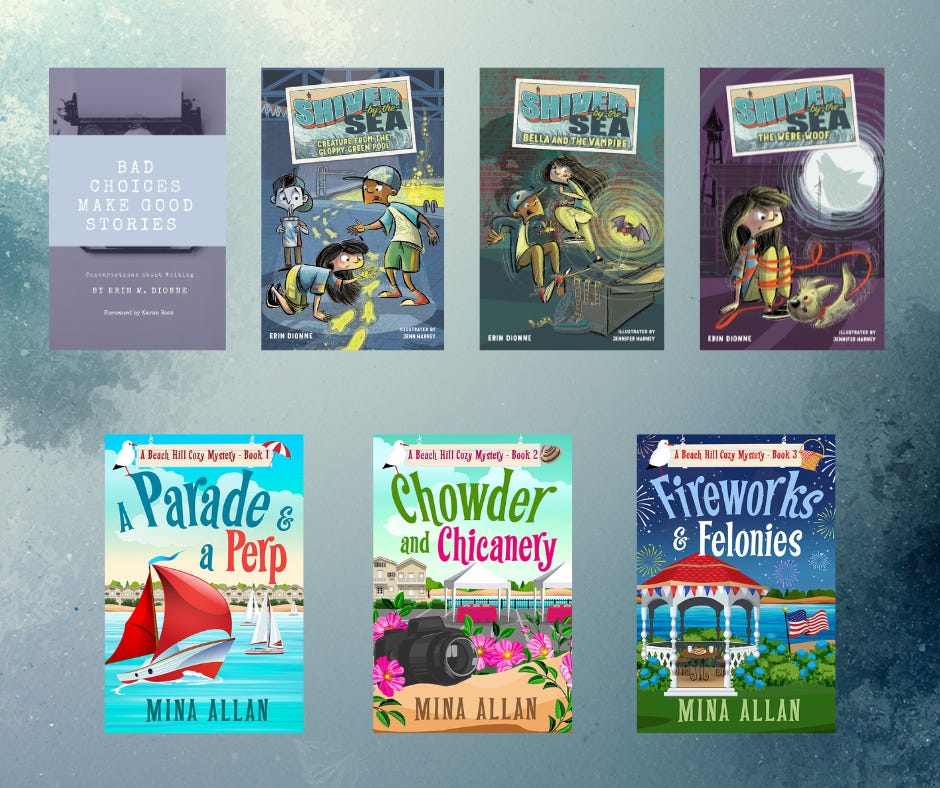
I’m kind of impatient, and like control. But I knew I had a learning curve ahead of me. So while listening to podcasts and learning about software and other tools, I decided that the best way to actually figure things out was to try it. At the time, I didn’t have access to my OOP titles, so I wrote a collection of essays about writing, managed to convince my critique group to start a small press so we could all learn together, and we used BAD CHOICES MAKE GOOD STORIES as a guinea pig/trial run book.
Although my critique partners and I all have different skills we bring to the table, the biggest hurdles for us were around design: interior layouts, covers, etc. I learned about the software app called Vellum, which allows you to create interior page layouts. And I started researching cover designers. For BAD CHOICES, I made the cover myself (and that’s gone through two versions).
We indie published that collection, and then were off to the races. Since then, I’ve written and released three full-length adult cozy mysteries under the pen name Mina Allan, and am getting ready to re-release my 2018 Scholastic novel, LIGHTS, CAMERA, DISASTER. I hired a designer to do the covers for the mysteries and LIGHTS.
I also joined author Michelle Zink’s Publishing Freedom Collective, where she teaches traditionally-published authors the skills and mindset you need to independently produce work. Her guidance and support has been incredible. As for what to consider—you have to realize that this is a hands-on process that takes time and has a learning curve. And that’s okay—just be patient and know that you will make mistakes along the way.
As for “feeling comfortable” with the process…well, I definitely understand and know all of the steps at this point, but there’s always something new to learn. One thing I’ve definitely learned is that change is a constant, and you have to be okay with being uncomfortable and trying things out.
I’m trying to cover each step in the process in my posts (where to find covers, how to get the ebook up versus print books, copyright, distribution, etc.). Have you any specific and strong (“yes, do this! Don’t do that!”) recommendations for “best of” lists? i.e., the best place to have covers made; the best copyediting help; the best place for print books, etc.
I always recommend that people use Draft 2 Digital for distribution: it’s one stop, one account, and you can submit works to libraries as well as retail establishments. They make everything really easy. I use their print on demand service for my paperbacks, and I’ve been really happy with them.
For the steps along the way…I’d suggest looking for copyeditors and developmental editors on Reedsy.com because the site vets all of their freelancers. You can work with editors who have had long careers at traditional publishing houses there, and feel comfortable knowing you are in good hands (full disclosure: I am a freelance editor on Reedsy).
How do you manage, specifically, distribution, i.e., getting those books into libraries and bookstores? Has that been a challenge?
I use Draft2Digital for library distribution, and Ingram Spark for my paperbacks, making them accessible to bookstores. For my middle grade books, I want them available online and easily discoverable, so the more places I can place them, the better! And since those books already had their traditional life, I don’t expect bookstores to stock them—only them to be available to order if someone goes in and asks.
For your OOP books, has the process been successful?
This is still in the trial phase for me, as LIGHTS will release late Feb/early March, with other titles to follow. I’m excited to see what happens with them!
I know you’re also now venturing into self-publishing new work (me, too!) How does that feel? Are you still publishing some things traditionally? What work do you consider better suited for one avenue versus the other?
Twinning! Honestly, it’s really fun to release new work this way. I created Mina Allan and the Beach Hill Cozy Mysteries specifically as an indie project. These books are short (around 40K words), and are just fun for me. I like being able to try new things and make mistakes without the pressure of a publishing contract—and if they make a little money, all the better (okay, the goal is for them to make money).
I still have an agent (the fabulous Jennifer Laughran), and my kidlit career is still firmly entrenched in the traditional market. I love doing school visits and working with kids, and I still have more to say to young readers. But the pandemic knocked me off my writing horse a bit, and the indie books helped me get my legs back under me. I’m currently working on a new middle grade novel that I’m really excited about, and doing the cozy mysteries on my own have helped me stay patient through the inevitable glacial pace of the traditional publishing industry.
As for what avenue is “best”—I think it depends on the project, honestly. I want the control around the cozy mysteries, and I want to re-release my OOP titles—so those are no-brainer for indie publishing. The school and library market are important to me, so my kidlit work is traditional (it’s harder to get into the school and library market as an indie). Plus, I love the kidlit community, and want to stay involved.
Any other thoughts or considerations I haven’t covered?
I think this is pretty comprehensive! If I can offer some advice to people, it’s to get your rights back for your Out of Print titles—whether you opt to re-release them or not. You created these beautiful stories, and once the publisher is done with them, you should have them back in your stable. This will allow you to make decisions about your work’s future.
Thank you so much, Janet! Thank you for having me.
My pleasure - and I love those covers!
THANK YOU! This was a fantastic read. I have attended workshops with Eric Dionne before and I am thrilled she is venturing into this new field. I published my first work with a small indie press in 2025, and since then I've been exploring (and learning) all the options we have as authors. Keep this excellent content coming!