

Changes in Children’s Publishing
What Does It All Mean?

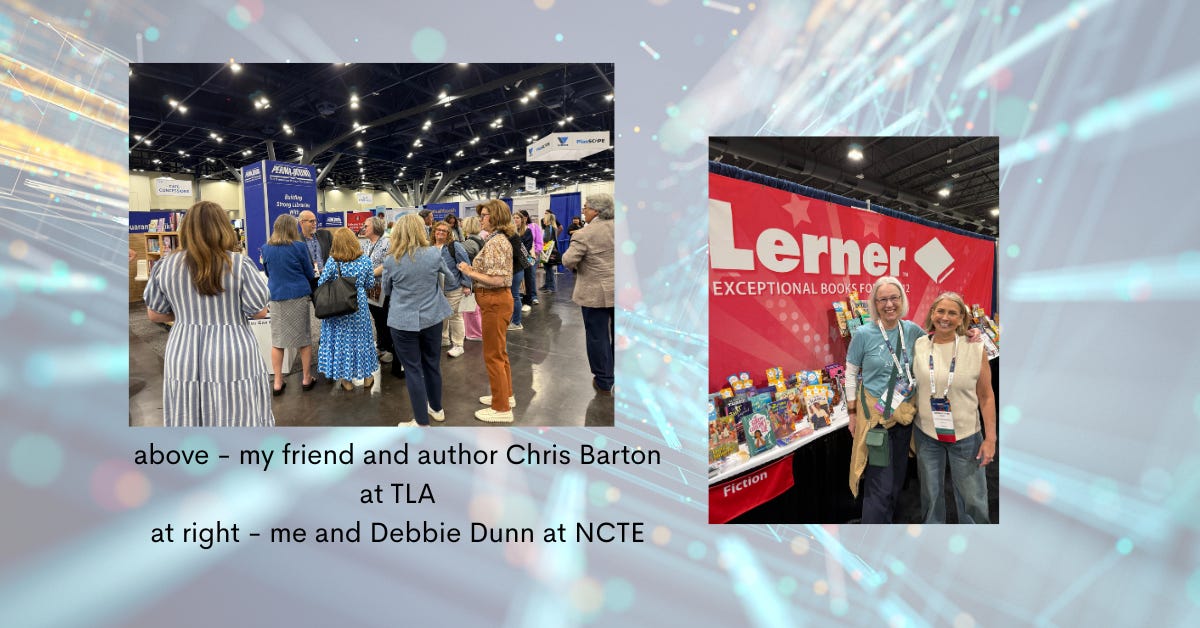
As I write this, I’m sitting in Denver airport on my way home from the annual Texas Library Association conference. TLA is a statewide Texas conference for public and school librarians, and these folks are a force of nature. It skews strongly towards books for young readers and many authors both local and national attend this event, so it’s a big crowd with large exhibition hall.
And that hall is filled with children’s books from all the major and second-tier publishers so it’s a great window into what is selling, what is being pushed, and who is being featured.
Since long before I was published, I’ve been attending this one; when we lived in Texas for 15 years I went every year. This has given me a “long-view” perspective of changes in children’s books, marketing, and the world of the kidlit librarian gatekeepers.
First, News From the Industry
If you haven’t seen the latest news, there’s been some significant down-sizing in the children’s publishing world in just the last few weeks.
First, on March 31, Macmillan announced the closure of the imprint Roaring Brook, which for over 20 years has published some of the most memorable children’s literature from picture book to young reader fiction. They plan to open a new imprint but it will focus on nonfiction and “illustrated books” (picture books? Graphic novels? We don’t know yet.) There were job losses as well as job shifts within the house.
And earlier in March Penguin Young Readers completely closed Dial Books for Young Readers and laid off staff in other children’s imprints as well.
These closures and layoffs are not entirely a new phenomenon - a number of earlier closures (i.e., Algonquin Young Readers) and layoffs in the past couple of years has the industry spinning.
What do these most recent closures mean? Two respected children’s book imprints are gone, and a host of talent is lost as well. This downsizing will impact all children’s book authors as we have lost avenues for publication.
A More Subjective Take
Second, what I saw at TLA:
Graphic novels all over. They are the hottest bricks on the block right now. Middle grade graphic novels dominate that age market.
If they aren’t graphic, they are short and illustrated with graphic covers.
Picture books are soft and poetic with very few words. Environment, animal, and lots of picture books with covers that evoke the natural world.
Fantasy/spec fiction for upper middle grade and young adult. Still incredibly hot, so much so that they all begin to blend into one cover image. Think: dragons, crowns, and swords.
Puzzle books, coloring books, work books, fun books. Appealing to short attention spans, maybe?
Heard these takes from librarians and industry people: librarians have no money to buy books; librarians are being told by higher ups what they can and cannot buy and it’s a strict list; the industry is in turmoil but fighting hard; publishers understand that their partnership with authors is more important than ever; short books are key; things have changed so much since Covid.
To That Last Point
It was my first time back at TLA since Covid, given that I no longer live in Texas, and didn’t have a book to pitch at the right time (that’s a big part of why authors go – to promote a brand new or upcoming title. I was there with my co-author Debbie Dunn to help promote our book which comes out today!).
What I saw was a vastly diminished conference. The exhibit hall is less than half of what it once was, the number of both librarians and authors down. The energy was still there, but it just wasn’t the same, and I think that is a sign of how hard things are right now for books and those of us who love them.
Bottom Line
I think what I saw and heard at TLA may explain what’s happening in the industry. School and library purchases are down both for financial and societal reasons. Those purchases are a mainstay of our industry, and schools are, simply put, buying fewer books and buying more conservatively (not politically, necessarily, but because they are watching their budgets.)
We are in trying times. Trying for books and readers. Trying for us authors, and very very trying for librarians. Even trying for publishers.
Keep writing, my dear author friends. Please. Children will need your stories more than ever. Things will change again – they always do – the pendulum will swing back, and you need to get your work out there, however you can.
And if you can get to TLA, or American Library Association conference, or National Council of Teachers of English conference - or any industry conference - you will learn a ton about our world. And, by the way, give your local librarian a hug or a high five.
Hi Janet,
I read your piece while you were reflecting from TLA, and what struck me immediately was the clarity of your perspective it didn’t feel like a surface level recap, but more like someone quietly connecting the dots between what’s happening in the room and what it means for the entire industry moving forward.
What stood out to me most is the balance you brought between the industry-level shifts and your personal, long term perspective. It didn’t feel reactive it felt informed. Especially the way you connected the closures, the shift in formats, and the realities librarians are facing it paints a much bigger picture than just “the market is changing.
Your observations from TLA were particularly insightful. The rise of graphic novels, shorter formats, and visually driven books alongside reduced budgets and tighter gatekeeping really highlights how both demand and access are evolving at the same time.
And that closing note encouraging authors to keep writing despite everything felt both realistic and quietly reassuring. Not overly optimistic, but grounded in experience.
I did have a quick question, if you don’t mind it would truly be an honor to hear your perspective.
With all these changes happening fewer publishing avenues, shifting reader preferences, and tighter institutional budgets how have you seen authors adapt when it comes to consistently getting their work in front of the right audience?
Congrats on the release of your new book!
These insights are helpful--I had heard of the closures and it's shocking. My heart goes out to librarians, too!!